
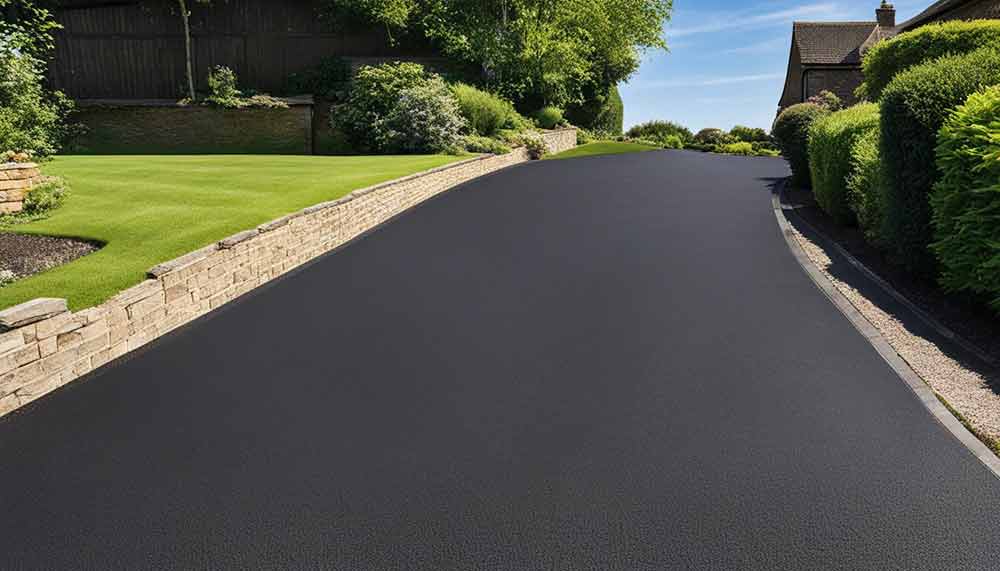
Calculating the quantity of material needed for your tarmac driveway is essential to ensure a successful project. Whether you’re a homeowner in Mansfield or a contractor working on a paving job, understanding the quantity of tarmac required is crucial to avoid wastage or shortages.
Tarmac, also known as asphalt, can be purchased in different forms such as bags, bulk sacks, or metric tonnes. Knowing the quantity of tarmac required is dependent on the dimensions of the area you want to cover. To start, you’ll need to measure the length, breadth, and depth of the space.
Once you have these measurements, you can calculate the square metres (m2) needed by multiplying the length by the breadth. Then, multiply the resulting area by the depth to determine the total cubic metres (m3) of tarmac required.
The density of tarmac can vary based on factors like the mix design and source rock density. However, a common density used in calculations is 2.4 tonnes per cubic metre (2400kg/m3). To calculate the number of tonnes needed, multiply the cubic metres volume by 2.4.
It’s important to note that the density of tarmac can affect the overall cost of your project. A highly dense material will require more tonnes to cover the same surface area compared to a low-density product.
For more accurate estimations, you can also calculate the quantity of tarmac based on ‘covers’, which takes into account the m2 per tonne based on layer thickness. This method is particularly useful when dealing with multiple layers and materials.
Now that you know how to calculate the quantity of tarmac needed, you can confidently plan and execute your tarmac driveway project in Mansfield. Remember to consider the density of tarmac when comparing costs between different plants and materials.

Calculating Tarmac Quantity Based on ‘Covers’
An alternative method for calculating the quantity of tarmac needed is based on ‘covers’. This method is particularly useful when different layers and materials are required.
The idea is to use the m2 per tonne based on a layer thickness. The exact density of the tarmac will determine the m2 per tonne. For example, a density of 2.4 tonnes per cubic metre (2400kg/m3) would result in an approximate m2 per tonne of 5.2.
To calculate the tarmac quantity using covers, divide the total m2 required by the m2 per tonne. This method provides a more accurate estimate when considering different layers and materials.
It’s recommended to contact your local asphalt plant for the density of tarmac in your area. By comparing the cost per tonne and the density, you can calculate the cost per cubic metre (m3) of tarmac. This allows for a proper cost comparison between different plants and material options. The cost per tonne may be lower, but the overall project cost can be higher if the density is higher.
The table below provides a cost comparison for different density scenarios:
| Tarmac Density (tonnes per cubic metre) | M2 per Tonne | Tarmac Quantity (m2) |
|---|---|---|
| 2.2 | 4.5 | 60 |
| 2.4 | 5.2 | 55 |
| 2.6 | 5.9 | 50 |
In this example, the cost per tonne may be lower for the tarmac with a density of 2.2 tonnes per cubic metre, but it would require 60m2 to cover the same area that only needs 55m2 with the tarmac density of 2.4 tonnes per cubic metre. Therefore, the overall project cost would be higher with the lower density tarmac.
By understanding the concept of ‘covers’ and considering the density of tarmac, you can make informed decisions when calculating the quantity and cost of tarmac needed for your project.
Conclusion
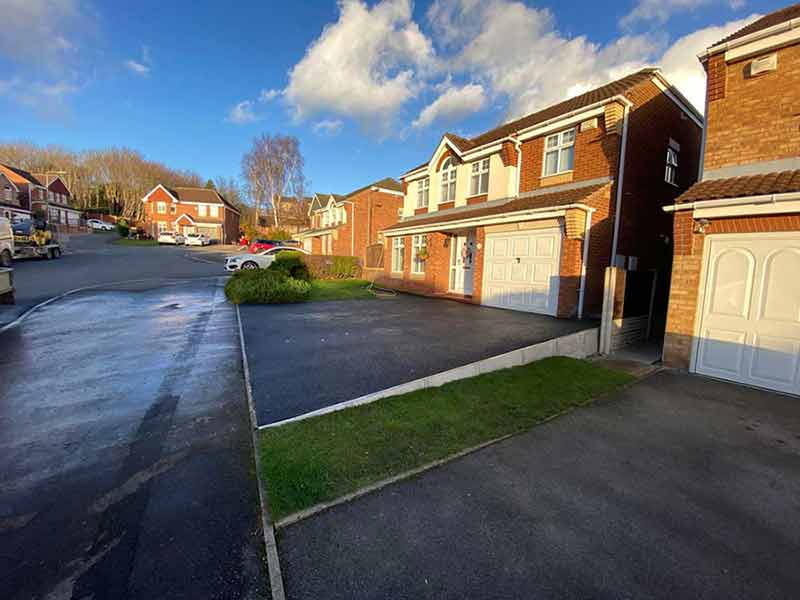
Calculating the quantity of tarmac needed for your paving job, such as a tarmac driveway in Mansfield, is crucial to ensure you order the right amount and avoid any wastage or shortages. By measuring the length, breadth, and depth of the area to be covered, you can accurately calculate the required square metres (m2) and cubic metres (m3) of tarmac.
The density of tarmac can vary, but a common value is 2.4 tonnes per cubic metre (2400kg/m3). It’s important to consider the density when comparing asphalt prices from different plants and materials.
By contacting your local asphalt plant, you can obtain the necessary information to calculate the cost per cubic metre (m3) of tarmac and make an informed decision.
Don’t forget to take advantage of an asphalt calculator to determine the tonnage of tarmac needed for your specific paving job. Ensure you measure the pavement accurately and choose the appropriate thickness based on your requirements. With the right calculations and estimation, you can effectively plan and execute your tarmac driveway or any other asphalt project.
For professional tarmac driveway services in Mansfield, visit https://asphaltdrivewaysmansfield.co.uk/. Their experienced team can assist you with quantity estimation, provide competitive asphalt prices, and deliver high-quality results for your paving needs.
Call us to get a price quote on a tarmac. Contact us today on 07595 510190 to receive a free quote or visit our website.
Source Links
- http://www.redstagmaterials.com/blog/
how-to-calculate-how-many-
tonnes-of-asphalt-required - https://www.heidelbergmaterials.co.uk/
en/tools/asphalt-calculator - https://www.pavertrend.com.au/
asphalt/asphalt-calculator
More Benefits of a Tarmac Driveway for Your Bingham Home A new tarmac driveway can bring a multitude of benefits Read more
Tarmac Driveway After Care Tips If it is well maintained, tarmac driveways will last many years. These tips will help Read more

Maintaining your tarmac driveway is an important task for any homeowner. Proper drainage can make all the difference between having Read more